Free Number Tracing Worksheets: Number Formation & Counting Practice for Kindergarten & Year 1
If you’ve done any handwriting practice with a young child, you already know that numbers get treated like an afterthought a lot of the time. Letters get all the cute worksheets, the themed packs, the seasonal sets — and numbers get a plain grid photocopied from somewhere and handed over without much thought. But number formation deserves exactly the same care as letter formation, for exactly the same reason: kids build habits early, and it’s much easier to teach a 5 to start in the right place the first time than to untangle a backwards, bottom-up scrawl two years later.
That’s what this new free printable is for. It’s a complete set of number tracing and formation worksheets covering 0 through 20, and it’s designed as the numeracy partner to the Alphabet Tracing & Letter Formation pack I shared recently. Same page layout, same guided handwriting lines, same “trace it, then try it yourself” approach — just for numbers instead of letters, with one extra piece built in that I think makes a real difference: a ten-frame on every page so counting and quantity get reinforced right alongside the writing practice.
Why number formation is worth its own practice
Kids can often recite numbers long before they can write them properly, and that gap causes more confusion than people expect. A child who can count to twenty out loud might still be forming their 2 as three disconnected pieces, or starting their 5 from the bottom, or drawing a 7 that drifts into looking like a 1. None of that is a big deal in the moment, but those habits get more stubborn the longer they sit, and by the time a child is doing simple addition on paper, shaky number formation just adds friction to a skill that should be getting easier, not harder.
There’s also a piece that’s easy to overlook: writing a numeral and understanding the quantity it represents are two different skills. A child can trace a perfect 7 without necessarily having a solid feel for what “seven” actually means in terms of a set of objects. That’s the gap this pack is built to close, which is why counting isn’t treated as a separate activity here — it’s built into every single page.
What’s in the pack
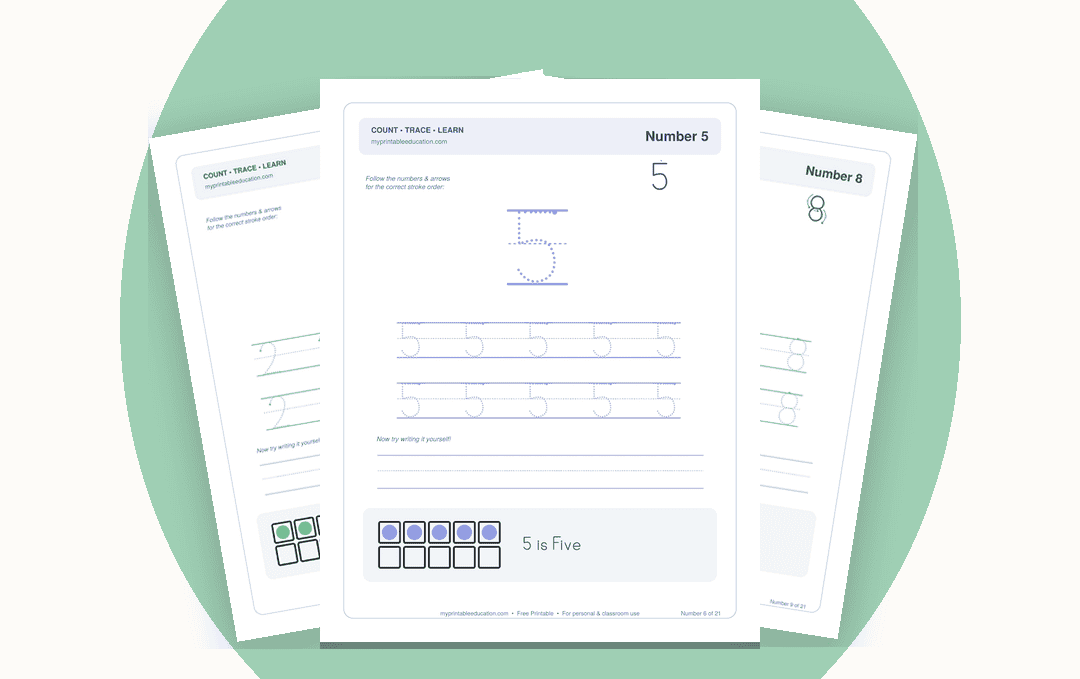
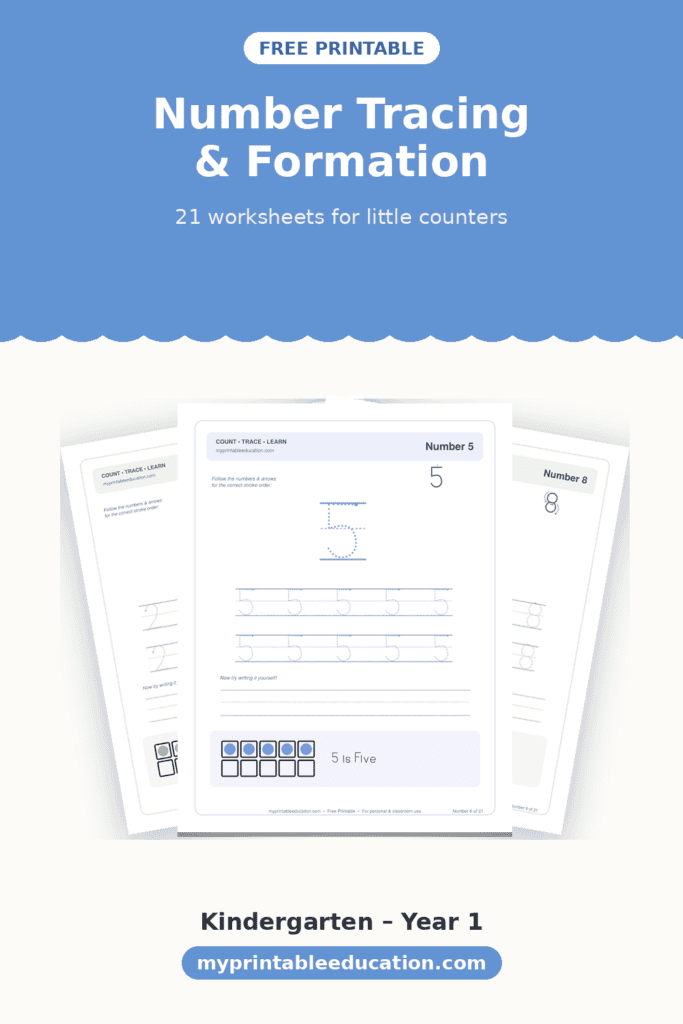
Every one of the 21 pages (0 through 20) follows the same layout, so once your child gets used to the first page, they’ll know exactly what to expect from all the others:
A big version of the number, made of soft dots for tracing with a finger before picking up a pencil. Same as with the alphabet pack, starting with a finger trace takes the pressure off before a pencil is even involved, and it turns the first attempt at any new number into something low-stakes rather than something that can be “gotten wrong.”
Underneath that, two rows of smaller practice numbers sitting on proper handwriting guide lines, so kids get a feel for where a number sits — which ones are tall, which stay small, and where a numeral like a 9 or a 7 needs to start. Two rows of guided repetition before anything is left to memory alone.
Then a blank practice line with no numbers at all, just the guide lines, so your child can try forming the number independently after a few rounds of tracing. This is genuinely the most useful bit for seeing where things actually stand.
And finally, the part I added specifically for this pack: a ten-frame at the bottom of every page, showing that number’s quantity as filled and empty squares, right next to the written-out number word (“7 is Seven”). A ten-frame is just a simple 2-row, 5-column grid — a classic, well-tested tool for building number sense, because it gives kids a consistent visual structure to count against instead of a random scatter of dots. For the teen numbers (11 through 20), there are two ten-frames side by side, with the first one shown full, which quietly sets up the idea that “eleven” is “ten and one more” well before that’s ever explained in words.
Like the alphabet pack, this one is designed to print cleanly in black and white, with a single soft accent color per page used only for the traceable numbers and the ten-frame dots. It won’t eat through a color cartridge, and the whole thing feels visually consistent from the cover page right through to twenty.
How I’d suggest using it
You really don’t need to work through this front to back in order. In fact, for numbers especially, I’d suggest following your child’s actual counting range rather than the page order. If your child confidently counts to ten but numbers beyond that are still shaky, spend more time in that 10–20 zone rather than ticking boxes from 0 upward.
A few things that have worked well for us:
Start with the ten-frame, not the tracing. Before your child picks up a pencil, point at the ten-frame and count the filled squares together out loud. Getting the quantity solid first seems to make the written numeral feel less abstract when they get to it.
Use the finger-tracing step properly rather than skipping straight to pencil. It feels like an extra step, but it’s a fast one, and it means the pencil rows go more smoothly because the motion isn’t brand new.
Talk through the teen numbers specifically. Eleven through nineteen are genuinely one of the trickier spots in early number sense (English doesn’t make it easy — “eleven” and “twelve” don’t even hint at “ten and one,” “ten and two” the way “thirteen” and “fourteen” eventually do). The two-ten-frame layout on those pages is there to make that relationship visible, so it’s worth pointing it out directly rather than assuming it’ll click on its own.
Don’t rush zero. Zero trips kids up more than people expect, because it’s the one number on an empty ten-frame — nothing to count. It’s worth spending a proper minute talking about what “zero” actually means before moving on.
A note on pacing
I’ve aimed this at Kindergarten through Year 1, but just like with the letters, number readiness varies enormously and doesn’t map neatly onto age or grade. Some children will fly through 0–10 and slow right down at the teens. Others will want to linger on the physical act of forming each numeral well past the point where counting itself feels solid. Both are completely normal, and there’s no benefit to pushing a child through pages faster than the actual skill is developing — a number traced without real attention doesn’t build much of anything.
If your child is still building the fine motor control to hold a pencil comfortably, the big dotted numeral with just a finger, or a dry-erase marker over a laminated page, is a perfectly good stand-in for as long as it’s needed before moving on to the smaller guided rows.
Grab the free printable
The full set is free to download below — print it at home on regular paper, no special settings needed. It pairs naturally with the Alphabet Tracing & Letter Formation pack if you’re working through both letters and numbers at the same time, but it stands on its own just as well if numbers are where your focus is right now.
If you use this one, I’d love to hear which numbers gave your child the most trouble — the teens seem to be the common culprit in my experience, but I’m always curious whether that holds true for other families too.
Happy counting!