Free Addition & Subtraction Fact Family Worksheets: Number Bonds to 10
There’s a habit that shows up in a lot of early math instruction almost by accident: addition gets taught for a while, then subtraction gets taught afterward as a separate, unrelated topic, and kids end up treating “7 + 3 = 10” and “10 – 3 = 7” as two different facts that happen to involve the same numbers. They’re not. They’re the same relationship looked at from opposite directions, and a child who understands that connection has effectively learned two operations for the price of one.
That connection is what this new free printable is built around. It’s a set of number bond and fact family worksheets covering every way to split the numbers 1 through 10 into two parts, with the matching addition and subtraction facts sitting side by side on the page instead of in separate workbooks weeks apart. It follows on from the Number Tracing pack the same way CVC Word Building followed on from Alphabet Tracing — same page anatomy, same clean black-and-white layout, but now moving from counting and writing numerals into actually operating on them.
Why number bonds work better than a worksheet of sums
A standard addition worksheet — rows of “3 + 4 =”, “5 + 2 =”, and so on — asks a child to solve one equation at a time, with no visible relationship between one row and the next. A number bond does something different: it takes a single number, like 6, and shows every pair of smaller numbers that combines to make it, all at once, radiating out from the same “whole” circle. Six can be 0 and 6, or 1 and 5, or 2 and 4, or 3 and 3, and seeing all of those splits on one diagram makes it obvious that they’re variations on the same idea rather than four unrelated problems to memorize separately.
That structure also makes subtraction fall out almost for free. If 4 and 2 combine to make 6, then a child who’s internalized that relationship doesn’t need a new rule to work out that 6 take away 2 leaves 4 — it’s the same three numbers, the same diagram, just read in a different direction. That’s the actual definition of inverse operations, and it’s a much sturdier foundation than teaching subtraction as its own topic with its own set of memorized facts that don’t obviously connect to anything a child already knows.
Number bonds are also just a well-established part of how early numeracy is taught for exactly this reason — the visual of a whole splitting into two parts (or two parts joining into a whole) gives kids something concrete to picture, which matters a lot before an abstract equation like “4 + 2 = 6” means anything on its own.
What’s in the pack
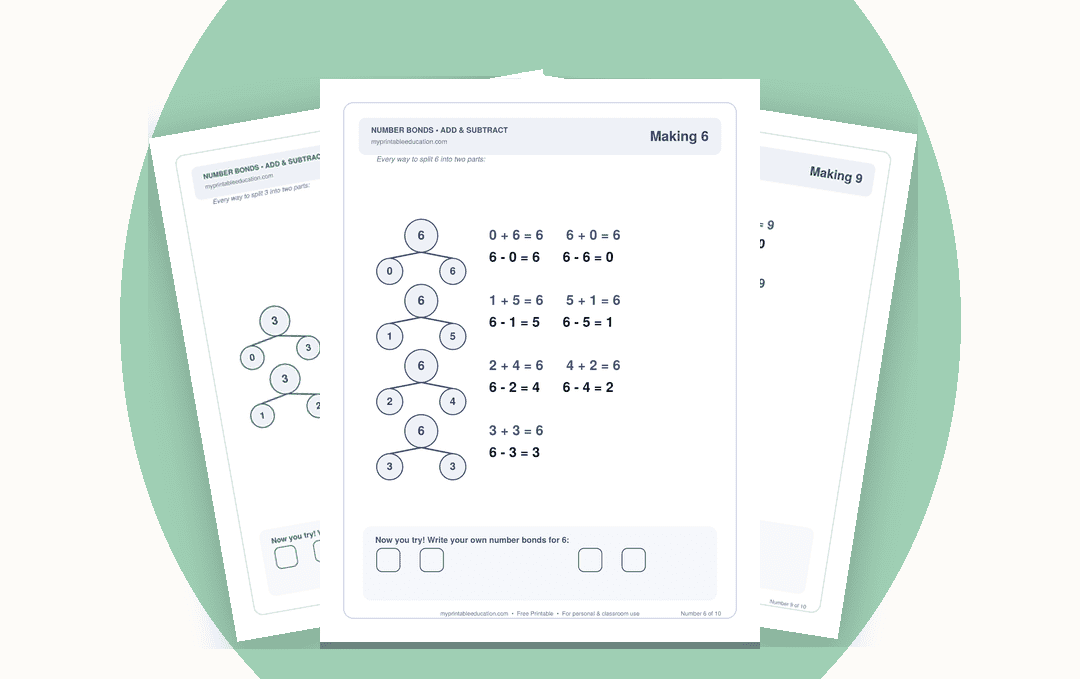
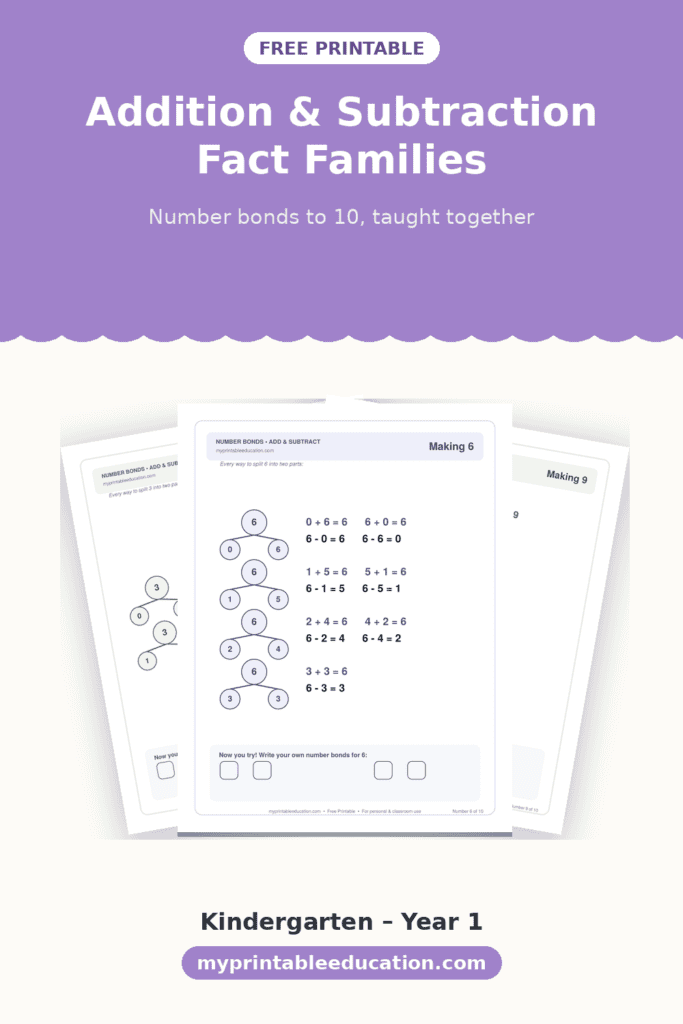
The set is a cover plus ten pages, one for each target number from 1 to 10. Every page follows the same layout: a subtitle stating the number being explored, then a stacked series of number bond diagrams showing every way to split that number into two parts — starting from 0 and the whole number itself, and working inward until the pairs meet in the middle.
Next to each diagram sit the matching equations: the two addition facts that pair works (both orders, since 3 + 4 and 4 + 3 are worth showing as distinct even though the answer’s the same), and the two subtraction facts derived from the same three numbers. So a single row for the pair 2 and 4 within the “Making 6” page shows “2 + 4 = 6,” “4 + 2 = 6,” “6 – 2 = 4,” and “6 – 4 = 2” all together, with the number bond diagram sitting right beside them as the visual anchor tying all four equations back to the same three numbers.
At the bottom of every page is a “now you try” section with blank equation templates — an empty addition frame and an empty subtraction frame for that page’s number — so a child can write their own number bond pairs by hand once they’ve worked through the pre-filled examples above. Pages with fewer possible pairs (like 1, which only splits into 0-and-1) keep the same clean layout without feeling like there’s wasted space, and pages with more pairs (10 has six of them, since it splits every way from 0-and-10 through 5-and-5) fit comfortably on the page without crowding.
As with the rest of the series, the pages print cleanly in black and white, with a single soft pastel accent color rotating from page to page — used for the number bond circles and connecting lines only, so nothing about it requires color ink to look right.
How to use it
There’s no strict requirement to work through the pages in numerical order, but for a child who’s new to number bonds, starting low and working up tends to make the pattern click faster. The pairs for 1, 2, or 3 are simple enough to almost see at a glance, which gives a child a chance to get comfortable with what a number bond diagram is even showing before the numbers get big enough that counting them out takes real effort.
It’s worth reading both the addition and subtraction lines out loud together rather than treating them as two separate steps — “2 and 4 make 6, so 6 take away 2 leaves 4” said as one connected sentence does more to build the inverse-operation idea than working through the addition column and then coming back to the subtraction column later. The number bond diagram in the middle is there to be pointed at while saying this out loud; it’s the thing that makes the connection visible rather than something a child has to take on faith.
The “now you try” section is worth treating as more than a formality. Asking a child to invent their own splits for a number — rather than just filling in ones that were already given — is what shows whether the underlying idea has actually landed, as opposed to the child having simply copied down what was already on the page.
A note on pacing
Fact families are one of those topics where a child can look completely fluent with an addition worksheet and then get genuinely stuck the first time the same numbers show up in a subtraction problem, simply because they haven’t yet made the connection between the two. That’s a completely ordinary part of learning this material, not a sign that something is going wrong — the whole reason this pack puts both operations on the same page is to help that connection form earlier rather than later, but it can still take repeated exposure before it clicks.
Some kids will move through all ten pages in a sitting or two; others will want to spend real time on the numbers under 6 before the higher numbers start to feel manageable. Both are fine. The pairs for 9 and 10 involve more simultaneous facts to hold in mind than the pairs for 2 or 3, so a slower pace on the later pages isn’t a sign of a problem — it’s just a reasonably harder task taking the amount of time a harder task takes.
Grab the free printable
The full set — a cover plus all ten number pages — is free to download below and ready to print at home on regular paper. It picks up naturally where the Number Tracing pack leaves off if a child has already been working through that one, and it stands on its own for anyone whose focus right now is specifically on building the connection between addition and subtraction rather than treating them as two separate subjects to learn from scratch.