
Free CVC Word Building Worksheets: Sound Out, Trace & Read 25 Short-Vowel Words
There’s a specific moment in early reading that trips up a lot of kids, and it isn’t about knowing the alphabet. A child can usually name every letter and its sound with total confidence, and still freeze the first time they’re handed a word instead of a letter. Knowing that “c” says /k/ and “a” says short-a and “t” says /t/ is one skill. Sliding those three sounds together into “cat” without losing your place halfway through is a completely different one, and it’s the one that actually turns a child into a reader.
That gap — between knowing sounds and blending them into words — is what this new free printable is built around. It’s a set of CVC (consonant-vowel-consonant) word worksheets covering 25 short-vowel words, and it’s designed as the natural next step after the Alphabet Tracing & Letter Formation and Number Tracing packs: same page anatomy, same guided handwriting lines, same trace-then-try approach, but now applied to whole words instead of individual letters or numbers.
Why CVC words are the standard starting point for blending
CVC words are usually the first real words kids are taught to read, and there’s a good reason phonics programs lean on them so heavily. The pattern is short, completely regular, and forgiving: three sounds, no silent letters, no unusual spelling patterns to memorize, just a straightforward consonant-vowel-consonant sequence that behaves exactly the way it looks. “Cat,” “hen,” “pig,” “sun” — sound out each letter in order, blend them together, and the word that comes out is exactly what you’d expect. That predictability is what makes CVC words such a reliable place to practice blending as a skill on its own, separate from the harder job of decoding irregular spelling.
It’s also why word families matter so much at this stage. Once a child can read “cat,” they’re most of the way to reading “hat,” “mat,” “sat,” and “rat” — the only thing that changes is the first sound, and everything else about the blending process stays the same. Recognizing that pattern is what starts to make reading feel less like decoding each word from scratch and more like applying something already known.
What’s in the pack
The set covers 25 words spread across ten different short-vowel families — words like cat, hen, pig, dog, and sun, plus their family members such as hat, map, van, bag, bed, jet, web, pen, pin, lid, fig, zip, pot, mop, log, box, cup, mug, tub, and bug. Every page follows the same structure:
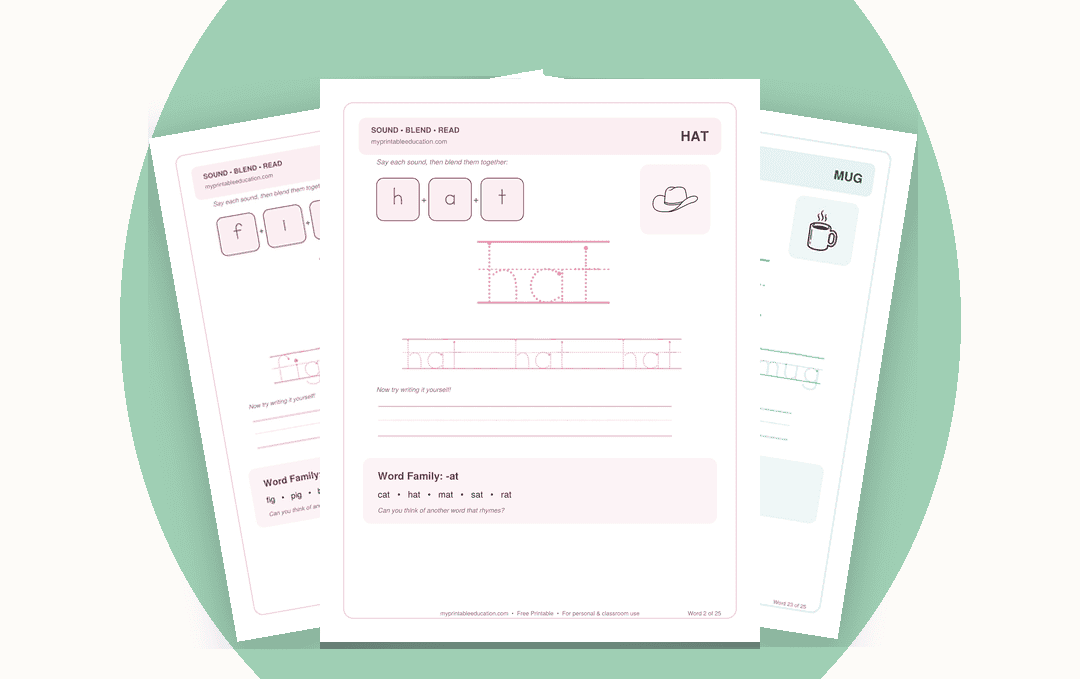
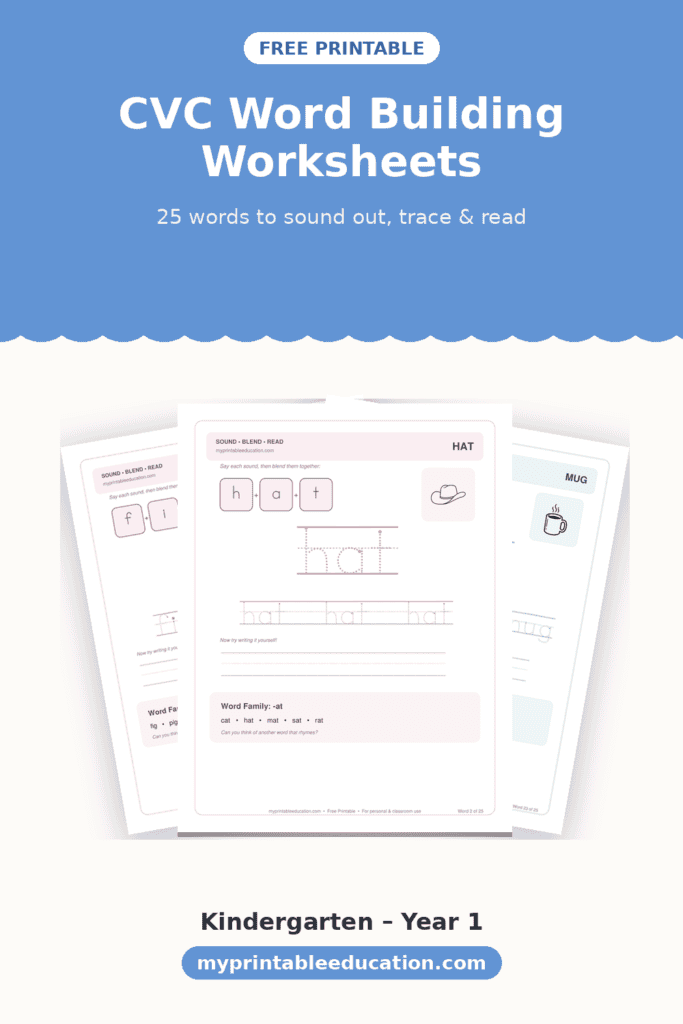
At the top, the word is broken into its three individual sound tiles — one letter per tile, with a plus sign between each — so the sounding-out step is visually separated from the blending step. A simple black-outline picture sits alongside the tiles as a quick visual anchor for the word.
Below that, a large dotted-and-lined trace of the whole word gives a first hands-on pass at writing it, followed by a shorter repeat-practice row for a second and third try. Then there’s a blank practice line with guide lines but no letters at all, so a child can attempt the word from memory once the tracing has warmed them up.
At the bottom of every page, a word family callout lists the other words that share the same ending sound, along with a simple prompt asking if they can think of another word that rhymes. It’s a small addition, but it’s the piece that turns each page from an isolated tracing exercise into part of a bigger, recognizable pattern.
Like the rest of the series, the pages are built to print cleanly in black and white, with a single soft accent color per page used only for the tracing and the tiles — nothing that requires a full-color print job or burns through ink.
How to use it
There’s no requirement to work through the pages in order. Since the words are grouped by vowel sound rather than alphabetically, it works well to focus on one family at a time — spend a session on the “-at” words, then move to “-ig,” rather than jumping between vowel sounds page by page. That keeps the pattern-recognition part of the exercise front and center instead of getting lost in variety.
For a child who’s just starting to blend, it can help to cover the word itself at first and work only from the sound tiles — say each sound slowly, then blend them together out loud before looking at the full written word. The tracing step works best after that blending has already happened verbally, so the hand is reinforcing a word the child has already successfully sounded out rather than copying shapes with no sound attached yet.
The word family box at the bottom of each page is worth pausing on rather than skipping past. Reading through the list together and asking which other rhyming words come to mind is a quick way to reinforce that decoding one word in a family makes the rest of that family easier, which is really the core idea CVC practice is trying to build.
A note on pacing
Blending is one of those skills that can click all at once for some kids and take a long stretch of repetition for others, and neither pace says much about how a child will read later on. A child who’s still sounding out each letter separately after several sessions with the same word isn’t behind — that’s a completely normal part of the process, and it usually resolves with more exposure rather than more explanation.
If a particular word family isn’t landing, it’s generally more useful to slow down and stay with it than to push forward to a new one. The whole point of the family groupings is that success with one word should make the next one easier; if that’s not happening yet, more time in that same family tends to help more than moving on.
Grab the free printable
The full set of 25 worksheets is free to download below, ready to print at home on regular paper. It follows on naturally from the Alphabet Tracing and Number Tracing packs if a child has been working through both, but it also stands alone for anyone whose focus right now is specifically on beginning reading and blending.


