Free Science of Cooking Worksheets: A Food Technology Pack for Middle School
Kids spend a lot of time around cooking — watching, helping, eating the results — without ever being told why any of it works the way it does. Why does a seared steak turn brown and a boiled one doesn’t. Why an egg white goes from clear and runny to white and firm. Why bread needs an hour to rise but pancake batter is already bubbling before it hits the pan. These are genuinely good chemistry questions hiding inside something a kid already has direct, hands-on experience with, and that combination — real science, but anchored in something familiar and edible — tends to make it stick in a way a more abstract chemistry unit doesn’t.
That’s the gap this new free printable is built for. The Science of Cooking is a food technology worksheet pack covering six kitchen phenomena — the Maillard reaction, protein denaturation, starch gelatinization, emulsification, leavening and fermentation, and food preservation — aimed at upper-primary through early high school. It isn’t written to any single curriculum’s specific outcome codes, deliberately, so it works whether you’re following a set food technology or science syllabus, building your own kitchen-science unit, or just looking for solid content-area reading that happens to be about something a kid already cares about.
Why cooking works well as a teaching structure
Cooking is really just applied chemistry that most kids have already watched happen dozens of times without anyone naming it. Rather than introducing “a chemical reaction” as an abstract concept first and looking for an example afterward, working through what’s actually happening in a hot pan or a mixing bowl makes the underlying idea concrete from the very first sentence — heat, protein, starch, and fat are behaving in specific, explainable ways, not just “cooking” in some vague sense.
Once that clicks, a lot of kitchen facts stop being disconnected trivia. A child who understands that browning needs both protein and sugar, not just heat, doesn’t need to separately memorise why a simmered stew never develops a crust the way a roast does — it falls out of the definition. A child who understands that yeast is a living organism producing gas as a waste product doesn’t need the hour-long rise time explained as an arbitrary recipe instruction; it follows from what yeast is actually doing. That’s the real value of teaching it this way — the explanation does the work that memorisation would otherwise have to do.
What’s in the pack
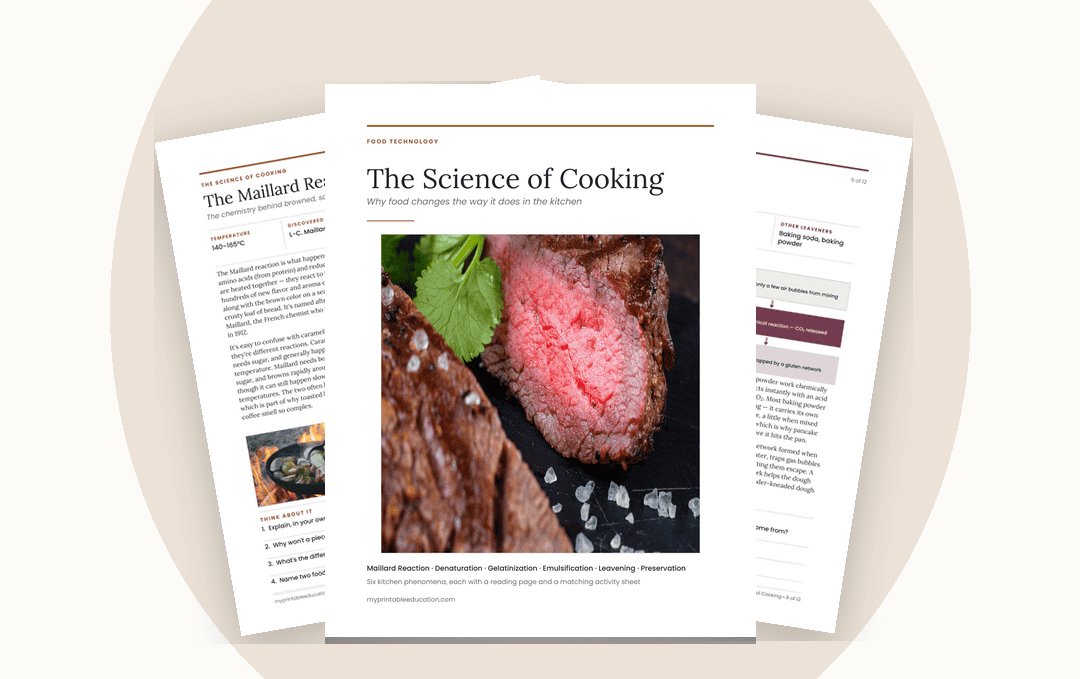
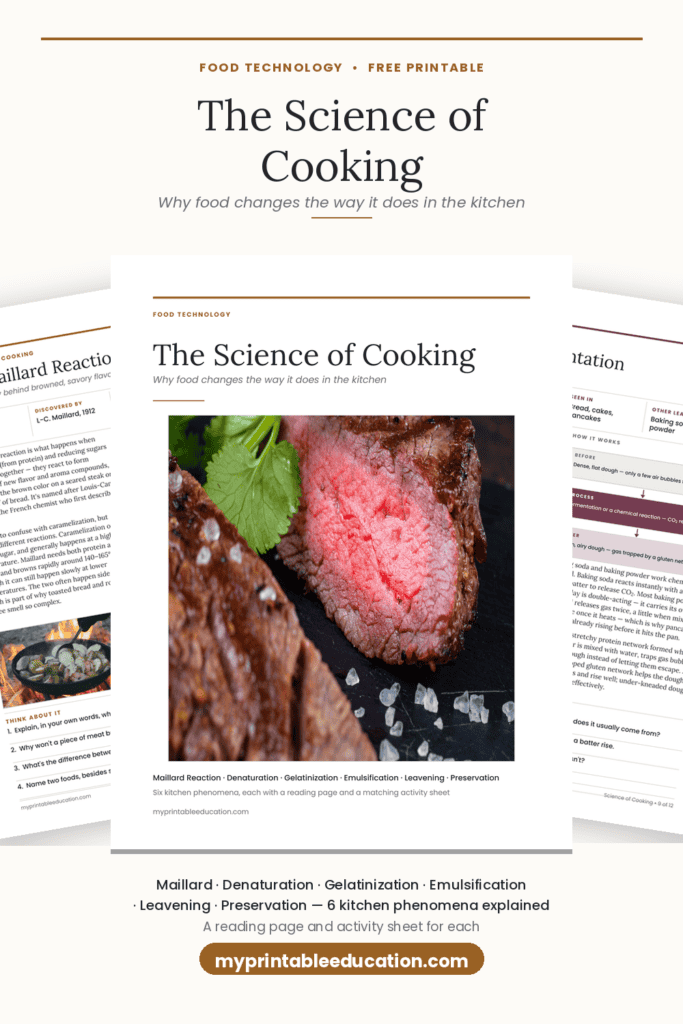
The set is a cover page plus twelve worksheet pages — two pages for each of the six topics. Every topic gets a reading page and a matching activity page, so the whole pack runs thirteen pages in total including the cover.
The reading page for each topic follows the same structure throughout: a short two-column reading passage explaining what’s actually happening at the food-science level, why it matters in the kitchen, and a common example or two; a key-facts strip along the top with the specific numbers and terms worth knowing at a glance — a temperature, a key ingredient, where it shows up, a defining idea; a simple “how it works” diagram walking through before, process, and after for that reaction; a real photograph tied to the topic; and a set of four open-ended comprehension questions at the bottom to work through, either in writing or as discussion.
The activity page that follows each reading page is there so the pack doesn’t require a separate exercise book to actually do anything with. Each one carries two varied exercises pulled directly from that topic’s content — a mix across the pack of fill-in-the-blank sentences with a word bank, true-or-false statements with space to correct the false ones, vocabulary matching, short-answer questions with ruled lines, and sequencing exercises where a short process (like a starch granule swelling as it gelatinizes, or dough rising as gluten traps gas) has to be put back into the right order. No two topics repeat the same pairing of exercise types, so working straight through the pack doesn’t start to feel repetitive.
How to use it
There’s no required order to work through the six topics in, though grouping the reading page and its matching activity page together as one sitting tends to work better than reading all six passages first and doing the activities afterward — the questions are much easier to answer accurately with the passage still fresh, or even still in view on the facing page.
The “how it works” diagram is worth pausing on rather than skimming past, particularly the first couple of times it comes up. It’s a simple three-step device — before, process, after — but it’s doing the real conceptual work of the whole pack: forcing a food reaction that can otherwise feel like a single instant (“it turned brown,” “it puffed up”) to be broken into a starting condition, a specific cause, and a resulting change. That’s the same basic move a lot of real experimental science asks for, just applied somewhere a kid can picture it happening in their own kitchen.
The comprehension questions on the reading pages are intentionally open-ended rather than one-word-answer — they’re built to be explained in a sentence or two, which makes them just as usable as a discussion prompt read aloud as they are as a written task. The activity pages, on the other hand, have specific right answers, and all of them can be checked directly against that topic’s reading passage, so there’s no separate answer key needed to mark them.
A note on level and pacing
Because the reading level and content here sit a good step above the early-years material a lot of free printable sites default to, it’s worth calibrating expectations a little. This isn’t a beginner reading task — the passages assume a reader who’s comfortable with a page of continuous text and can hold a two-paragraph explanation in mind while answering a question about it. Used with an upper-primary child, that might mean reading the passage together and talking through the questions rather than expecting fully independent written answers; used with an early high schooler, it should sit at a comfortable independent level on its own, and pairs naturally with an actual cooking session if you want to make the connection to real food even more direct — searing something to watch the Maillard reaction happen, or whisking a vinaigrette to feel it separate again a few minutes later.
The six topics aren’t ordered by difficulty, so there’s no particular reason to start at the Maillard reaction and work straight through to preservation — picking whichever topic connects to something already being cooked or studied, or just whichever one sounds most immediately interesting, works just as well as going in order. Some topics will naturally generate more discussion than others simply because there’s more going on: emulsification’s “why does it separate again” question and leavening’s contrast between yeast and baking soda both tend to spark more back-and-forth than, say, the more single-note explanation of gelatinization.
Grab the free printable
The full set — a cover page plus a reading page and activity sheet for each of the six kitchen phenomena, thirteen pages in total — is free to download below and ready to print at home. It stands alone as a general introduction to the science behind everyday cooking for anyone building out a food technology or kitchen-science unit, and it’s designed so that between the reading passages and the built-in activity pages, nothing else needs to be pulled together to actually use it.