Free World Biomes Worksheets: A Geography Pack for Middle School, with Built-In Activity Sheets
Most kids can rattle off the word “rainforest” and picture green and rain, or hear “desert” and picture sand and heat. What tends to get skipped, especially once kids move past the picture-book stage of geography and into the years where they’re capable of real explanation, is the why. Why does a band of land near the equator stay hot and wet all year while a similar distance from the equator, but further inland, turns into desert? Why does a forest in Ontario lose its leaves every autumn while one in the Amazon never does? Biomes are one of the cleanest ways to teach that kind of systems thinking — climate, latitude, and geography interacting to shape entire ecosystems — and it’s surprisingly hard to find solid, general-purpose material for it once a child is past the early years but not yet deep into a specific exam syllabus.
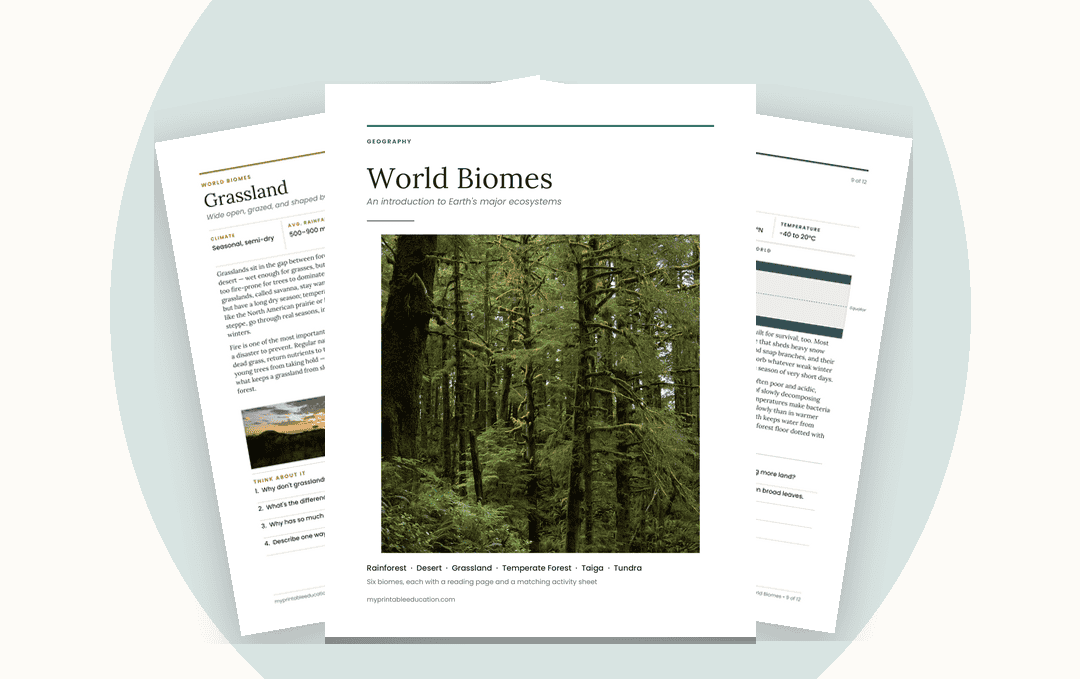
That’s the gap this new free printable is built for. World Biomes is a geography worksheet pack covering six of Earth’s major biomes — tropical rainforest, desert, grassland, temperate forest, taiga, and tundra — aimed at upper-primary through early high school. It isn’t written to any single curriculum’s specific outcome codes, deliberately, so it works whether you’re following a set syllabus, building your own unit on ecosystems or world geography, or just looking for solid content-area reading that isn’t another round of grammar or times tables.
Why biomes work well as a teaching structure
A biome is really just an answer to a question kids are already curious about: why does the natural world look so different in different places? Rather than listing facts about “the rainforest” and “the desert” as two unconnected topics, working through several biomes side by side makes the underlying pattern visible — climate (temperature and rainfall) plus location (mainly latitude) largely determines what kind of plants and animals a region can support, and those plants and animals are usually visibly adapted to the exact conditions they’re dealing with.
Once that pattern clicks, a lot of individual facts stop needing to be memorised in isolation. A child who understands that deserts are defined by low rainfall rather than high heat doesn’t need to separately memorise that Antarctica contains deserts — it falls out of the definition. A child who understands why conifers keep their needles through winter doesn’t need that fact handed to them as a disconnected trivia item; it follows from what a conifer is dealing with in a taiga winter. That’s the real value of teaching biomes as a set rather than one-off topics — the comparison between them is doing a lot of the explanatory work.
What’s in the pack
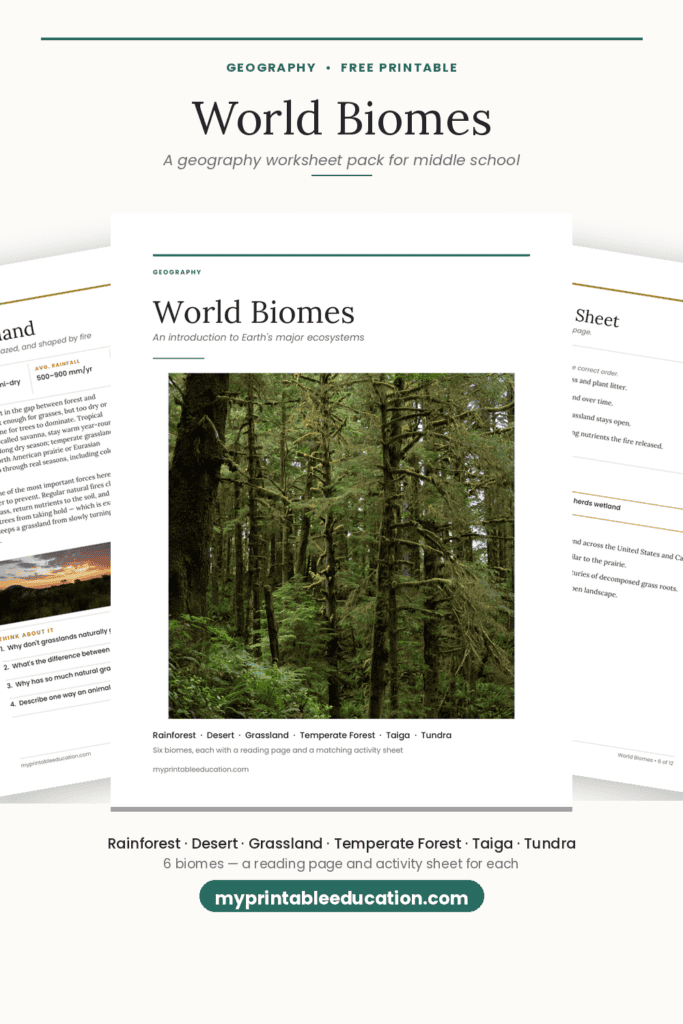
The set is a cover page plus twelve worksheet pages — two pages for each of the six biomes. Every biome gets a reading page and a matching activity page, so the whole pack runs fourteen pages in total including the cover.
The reading page for each biome follows the same structure throughout: a short two-column reading passage covering the biome’s climate, its typical location, and what makes its plant and animal life distinctive; a key-facts strip along the top with climate, average rainfall, typical location, and temperature range at a glance; a simple “where in the world” diagram showing which latitude band the biome is usually found in, from polar through temperate to tropical; a real photograph of the biome; and a set of four open-ended comprehension questions at the bottom to work through, either in writing or as discussion.
The activity page that follows each reading page is new, and it’s there so the pack doesn’t require a separate exercise book to actually do anything with. Each one carries two varied exercises pulled directly from that biome’s content — a mix across the pack of fill-in-the-blank sentences with a word bank, true-or-false statements with space to correct the false ones, vocabulary matching, short-answer questions with ruled lines, and sequencing exercises where a short process (like how fire maintains a grassland, or how a taiga forest cycles through its seasons) has to be put back into the right order. No two biomes repeat the same pairing of exercise types, so working straight through the pack doesn’t start to feel repetitive.
How to use it
There’s no required order to work through the six biomes in, though grouping the reading page and its matching activity page together as one sitting tends to work better than reading all six passages first and doing the activities afterward — the questions are much easier to answer accurately with the passage still fresh, or even still in view on the facing page.
The “where in the world” diagram is worth pausing on rather than skimming past, particularly the first couple of times it comes up. It’s a simple device — five horizontal bands from polar to tropical and back to polar, with the relevant band highlighted for that biome — but it’s doing the real conceptual work of the whole pack: connecting a biome back to where on the globe it actually sits, rather than leaving it as a description floating free of geography. Grassland is the one biome in the set that spans two bands rather than one, since tropical savanna and temperate grassland are different enough in climate to be worth noting separately, and that’s a good one to stop on and ask why a single “biome” can show up in more than one climate zone at all.
The comprehension questions on the reading pages are intentionally open-ended rather than one-word-answer — they’re built to be explained in a sentence or two, which makes them just as usable as a discussion prompt read aloud as they are as a written task. The activity pages, on the other hand, have specific right answers, and all of them can be checked directly against that biome’s reading passage, so there’s no separate answer key needed to mark them.
A note on level and pacing
Because the reading level and content here sit a good step above the early-years material a lot of free printable sites default to, it’s worth calibrating expectations a little. This isn’t a beginner phonics-level reading task — the passages assume a reader who’s comfortable with a page of continuous text and can hold a two-paragraph explanation in mind while answering a question about it. Used with an upper-primary child, that might mean reading the passage together and talking through the questions rather than expecting fully independent written answers; used with an early high schooler, it should sit at a comfortable independent level on its own.
The six biomes aren’t ordered by difficulty, so there’s no particular reason to start at rainforest and work straight through to tundra — picking whichever biome connects to something already being studied, or just whichever one is most immediately interesting, works just as well as going in order. Some biomes will naturally take longer than others simply because there’s more going on: grassland’s two-zone climate picture and taiga’s more involved seasonal cycle both tend to generate more discussion than, say, desert’s more single-note definition.
Grab the free printable
The full set — a cover page plus a reading page and activity sheet for each of the six biomes, fourteen pages in total — is free to download below and ready to print at home. It stands alone as a general introduction to world biomes for anyone building out a geography or Earth science unit, and it’s designed so that between the reading passages and the built-in activity pages, nothing else needs to be pulled together to actually use it.